Autumn hiking safety: five things to agree with your family before you set off
Five things to agree with your family
before an autumn hike
When the weather cools and the leaves start to turn, more people head for the mountains. The problem is that as the number of hikers rises, so does the risk of mountain accidents — getting lost, falls, sudden illness.
A fire service in Jeonbuk, a province of South Korea, analysed mountain accidents in its area from 2023 to 2025: of 1,957 in total, 229 happened in September and 245 in October. Together those two months account for 474, or 24.3% of the total. This is data from one Korean province and should not be read as applying nationally there, let alone elsewhere — but it does show why safety preparation is worth doing before an autumn hike. Figures and seasons differ by country, so it is worth checking what your own area's rescue services report.
Hiking safety rests less on what you do after an accident than on what you settle before you set off.
1. Start by telling your family the route, the difficulty and your expected time down
Rather than leaving it at "I'm off up such-and-such mountain," it is better to tell them the actual route and when you expect to be down.
The fire service urged hikers to check the distance and difficulty of the route, the expected time it takes and the time of sunset in advance, and to make a plan that matches their fitness.
Share at least these three things with your family:
- Which trail you are going up
- Roughly when you expect to be down
- By what time, if there is no word, they should check again
The more you hike alone, the more these standards matter.
2. Set a time to check, rather than "let's wait a bit longer if there's no answer"
On a mountain you may not see your phone, or the signal may be unreliable. But it is not realistic either for your family to keep calling every time you are slow to reply.
It helps to set the check-in points before you leave.
For example:
- Before starting the hike
- At the summit, or a rest point partway
- After finishing the descent
- Your family checks if you are more than a set time later than planned
Agreeing this makes it easier to tell an ordinary delay from a situation that really needs checking.
3. Stay on the marked trail and note the location markers
One of the most dangerous things to do when lost is to keep moving without knowing the direction.
Fire and rescue services advise that if you get lost or have an accident on a hike, you should not push on, but check the location markers or numbered location references around you and call the emergency services from a safe spot. These reference systems differ by country, so check in advance what your area uses.
Photographing the markers as you pass them helps too. It can be the clue that lets you describe where you are at the moment you need to call for help.
4. Prepare for the battery and the signal running out
GPS maps, hiking apps and safety apps can all be limited when your phone has no battery or the signal drops.
Before you leave:
- Charge your phone fully
- Prepare a power bank
- Check data and location permissions
- Save the maps or route information you need in advance
- Check you have spare clothing and emergency food for changes in temperature
Taking a lot of photos and video, or leaving GPS on for a long time, can run the battery down faster than you expect. It is safer to plan for the app not working than to think "I have the app, so it's fine."
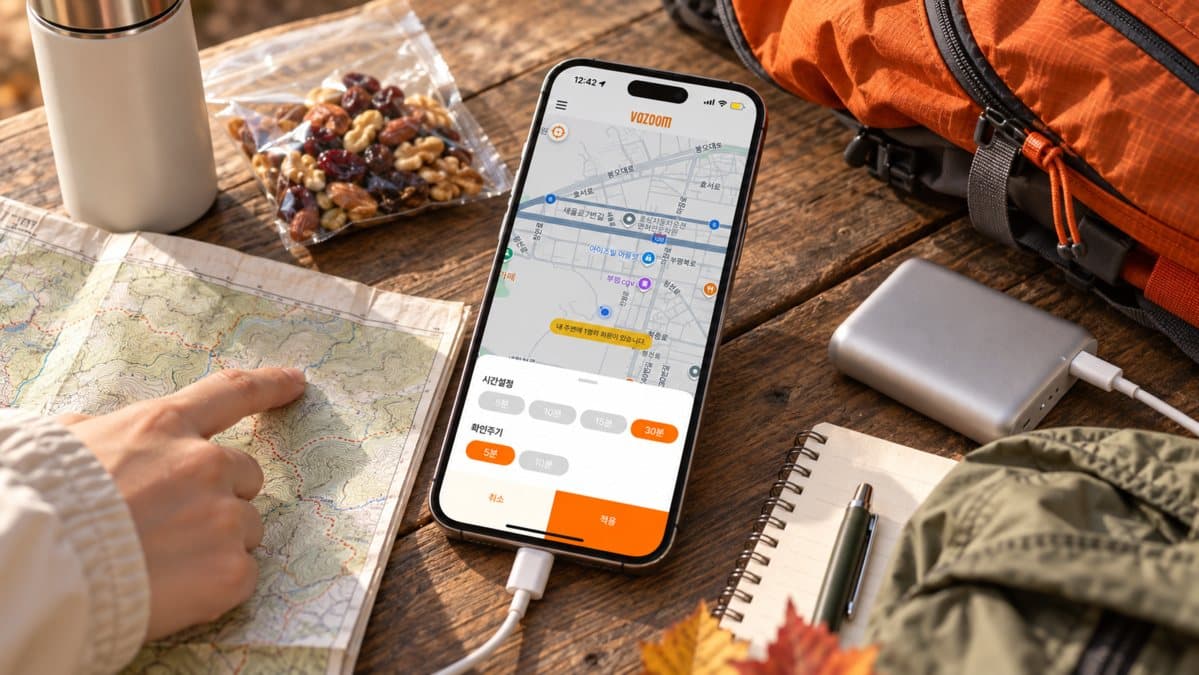
5. Set VAZOOM guard mode before the hike
If you are injured or faint on a mountain, it can be hard to find your phone and make a call yourself.
VAZOOM is a personal-safety app: you set in advance the time that needs watching, guard mode runs for it, and if you cannot answer the safety check it is designed to send an alert and your location to the guardians you registered.
When hiking alone or on a quiet route, you can use it by setting guard mode before you start, and telling your guardian the day's plan as well.
If you use a smartwatch you can also use heart-rate-based safety checks, depending on the device and settings — but VAZOOM is not a medical device that diagnoses illness or determines whether something such as cardiac arrest has occurred.
What to do first if there is an accident on the mountain
If you are actually lost or injured, you must not simply wait and trust a safety app.
If you are in a position to call, contact the emergency services and pass on whatever identifies where you are — a location marker, a numbered location reference, the trail name. If you are lost, calling for rescue from a safe spot matters more than pushing on.
VAZOOM is not a rescue service that stands in for the emergency services either. On a mountain, you also have to allow for location accuracy and alert delivery times varying with GPS reception, the signal and your battery state.
Autumn hiking safety starts before you climb
A contact plan matters as much as packing your boots and water.
Agree with your family in advance which route you are taking, when you will be down, and when they should check. And if you are hiking alone, or the situation needs an extra safety check, setting VAZOOM guard mode before you set off is one way to do it.
Because there is no guarantee you will be able to make the call yourself in the dangerous moment.
FAQ
Q. What should I tell my family first when hiking alone?
A. Rather than only naming the mountain, share the trail, the expected time it takes, the expected time down, and the time by which they should check again if they have not heard from you.
Q. If I get lost on a mountain, is it best to keep heading down?
A. If you cannot be sure of the direction, it is important not to push on. Check the location markers or numbered location references around you and call the emergency services from a safe spot.
Q. If I have a hiking safety app, do I still need to call the emergency services?
A. Yes. A safety app is a supporting tool that helps family or a guardian see what is happening. If an accident or a loss of your way actually happens, you have to contact the emergency services directly where you can.
Q. When is a good time to use VAZOOM while hiking?
A. You can use it by setting guard mode before the hike starts, for the time that needs watching — hiking alone, or taking a quiet route.