How a smartwatch heart-rate alert differs from a "safety check"
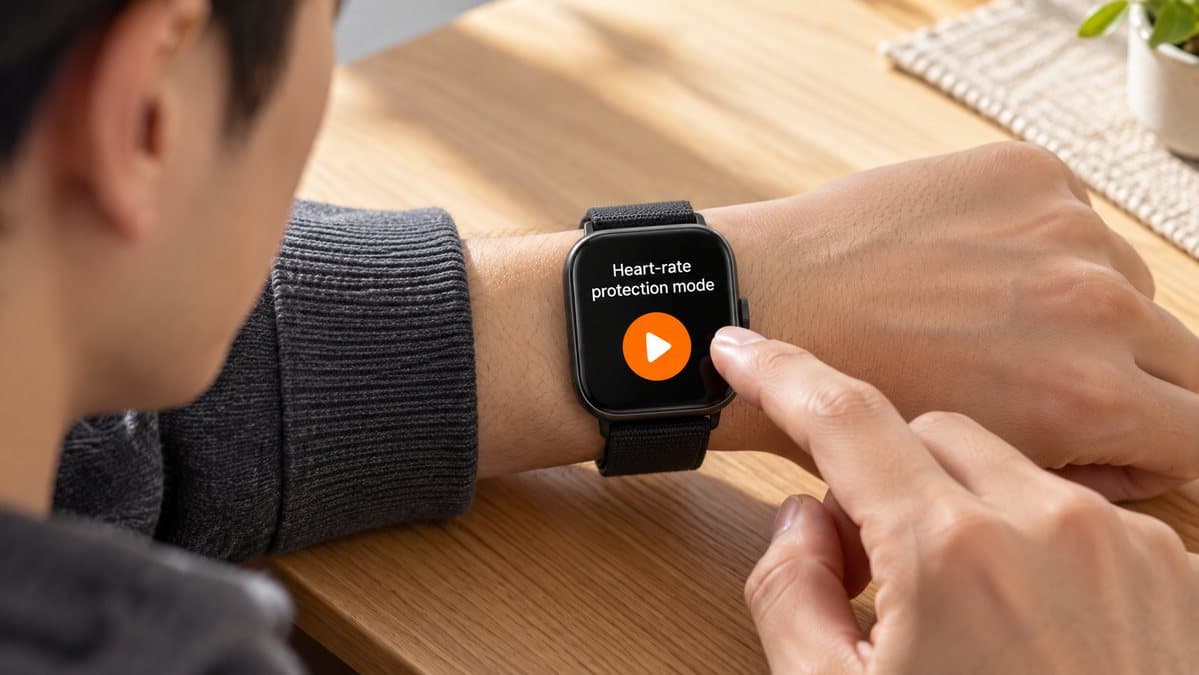
If your smartwatch has told you "your heart rate is high" or "your heart rate is low," there is something to separate out first.
A heart-rate alert means the watch detected a change in heart rate meeting certain conditions. A safety check is the process of using that signal as a prompt to confirm you are all right, and connecting to your guardian if needed.
They look similar, but they do different jobs.
1. A smartwatch heart-rate alert is fundamentally a feature that tells you
On supported models and settings, Apple Watch can notify you when your heart rate stays above or below a threshold you chose for a certain length of time.
Galaxy Watch also offers heart-rate monitoring and related alerts depending on the model and software settings. The exact menus and supported range can differ with the device and OS version.
The important point is that these alerts are not a diagnosis.
Heart rate can change for many reasons — exercise, nerves, caffeine, sleep, how the watch is worn, sensor contact. A watch alert alone cannot tell you whether something like cardiac arrest, a stroke or a heart attack has occurred.
2. Seeing a heart-rate alert does not mean the situation reaches your family automatically
A typical watch alert goes to the person wearing it first.
After that, the user has to see the alert and, if needed, contact family or ask for help.
The problem is that in a real emergency the user may not be able to operate a phone or a watch.
That is why, in a personal safety app, what matters is less the sensor signal itself than the safety-check process that follows it.
3. VAZOOM uses the heart-rate signal as a prompt for a safety check
VAZOOM is designed to work with supported smartwatches so that, when the heart-rate-related conditions you set are detected, it can run a safety-check flow.
In the current release, the core of it is:
- Using heart-rate-related conditions on supported watches for the safety check
- Asking the user whether they are safe
- Alerting the registered guardians if the user cannot answer
- Sending the guardian the location
- Up to three guardians can be registered
So it is closer to a structure of "when a particular signal occurs, confirm the user is all right, and connect to a guardian if there is no answer" than to diagnosing illness from a heart-rate number.
4. Keep medical features and personal safety features separate
Heart-rate data can be a useful reference for understanding your body, but a personal safety app cannot stand in for a medical provider.
If you have real symptoms — chest pain, difficulty breathing, reduced consciousness, severe dizziness — or an emergency is suspected, the judgement of the emergency services or a medical provider comes first.
VAZOOM, too, is not a medical device that diagnoses illness or determines whether a particular condition has occurred.
5. What to check before using smartwatch safety features
Simply wearing a watch does not complete a safety feature.
Before you rely on it, check:
- Which watch models and app versions are supported
- The connection between your watch and your phone
- The heart-rate measurement settings
- Notification permissions
- The battery on both your phone and your watch
- Whether your guardians are registered
- That a test alert actually arrives
In particular, a loosely worn watch or poor sensor contact can change measurement quality, so it is worth following the manufacturer's guidance on how to wear it.
6. When features like this are useful
It is more appropriate to see smartwatch-based safety checks as supplementing personal safety in situations like these, rather than as medical diagnosis:
- Exercising or walking alone
- Hiking or running alone
- Travelling a long distance alone
- Walking home alone late at night
- Hours when your guardian is not right beside you
The point is not to fear a single heart-rate number, but to shorten the time nobody knows when a signal appears that is different from usual.
FAQ
Q. If I get a smartwatch heart-rate alert, is it an emergency?
A. No. Heart rate can change with activity, stress, sleep, how the watch is worn and other factors. If you have symptoms or suspect an emergency, get the judgement of a medical provider or the emergency services.
Q. Does VAZOOM diagnose heart conditions?
A. No. VAZOOM is not a medical device and does not diagnose whether a particular condition has occurred. Heart-rate-related conditions are used as a signal to check again on the user's safety.
Q. Does it work with both Apple Watch and Galaxy Watch?
A. VAZOOM develops and operates its release scope around Apple Watch and Galaxy Watch integration. For the models and OS conditions actually supported, the accurate source is the app's current guidance.