How to put your family at ease abroad without messaging "I've arrived" every time
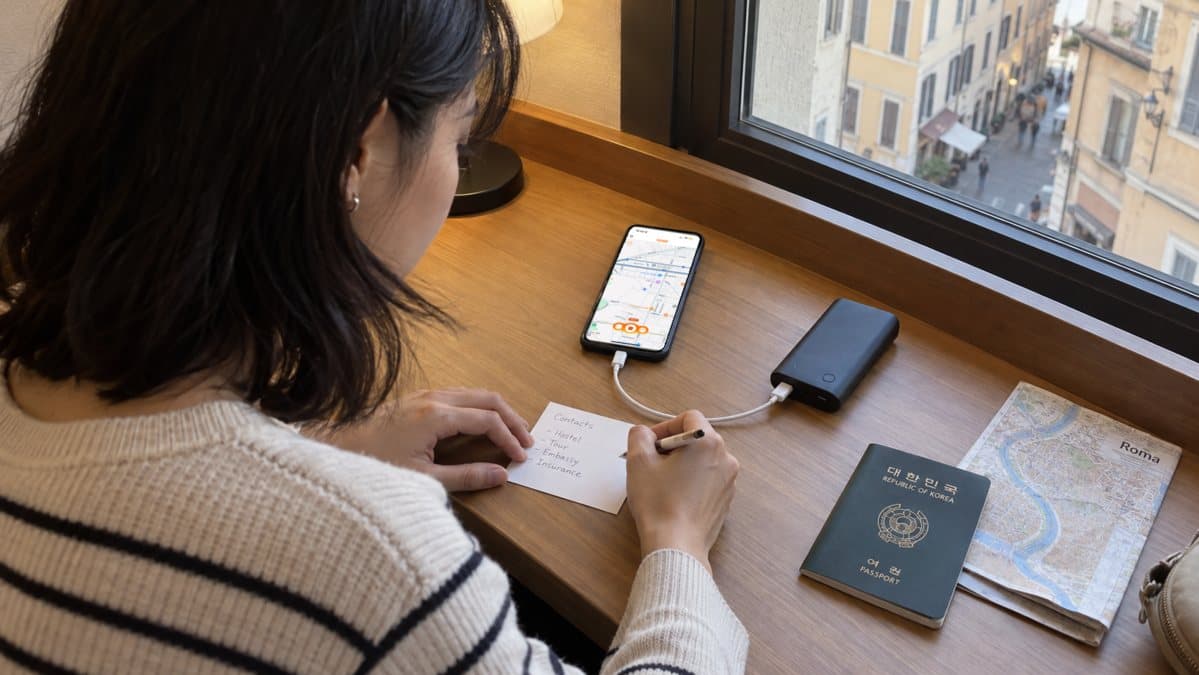
Travel abroad and it is easy to fall into the same exchange with family back home.
"Did you land?"
"Are you at the hotel?"
"Where are you going today?"
"Why aren't you answering?"
The worry is natural, but messaging home every time you move is hard to keep up for long.
For safety abroad, it is more practical to settle *when* you will check in and *what happens* if you do not — rather than how many times you message.
1. Check the official travel advice for where you are going before you fly
Do not judge conditions on the ground from social-media posts or search results alone.
Start with your own government's travel advice for the country and region: the advisory level, recent safety notices, and contact details for your embassy or consulate.
Risk can differ from region to region inside one country, and things can change while you are there — so on a longer trip, check again once you arrive.
2. Share the key movements with your family, not the whole itinerary
You do not need to share every restaurant and sight.
What your family actually needs is roughly this:
- Your flight and expected arrival time
- The name and address of where you are staying
- When you are travelling between cities
- When you will be travelling alone
- When you will tell them if the plan changes significantly
Too much information can bury the changes that matter.
3. Cut your check-ins down to three or four
Instead of "message whenever you get a chance," set the points.
For example:
- After you land at the local airport
- After you reach your accommodation
- Before you set off alone late at night
- After the day's plans are over
You can settle on something like that.
Also agree who calls first if you are more than a certain amount late, and what they do if there is still no answer.
4. Keep your emergency contacts somewhere you can read them offline
In case you lose your phone or the battery dies, it is worth keeping this on paper or in a separate file:
- The local emergency number
- Emergency contacts for your country's embassy or consulate
- Your foreign ministry's emergency consular line
- Your travel insurer
- The address of where you are staying
- Family emergency contacts
If you are travelling with someone, check that you each know the other's emergency contacts.
5. Test your battery, data and location settings before you leave
Map apps, ride-hailing apps, translation apps and safety apps all depend on your connection and your battery.
Decide in advance how you will handle roaming, an eSIM or a local SIM, and save your accommodation address and how to get there offline, in case you cannot connect the moment you land.
For apps that need location and notifications, it is worth checking the permissions and the background settings too.
6. You do not need to publish your itinerary as it happens
Telling your family where you are is not the same as posting your current location publicly.
When travelling alone, set the audience carefully for anything that affects your security: your room number, the fact that you are currently alone, the specific times and places you are heading to next.
The details that need sharing are better shared only with people you trust.
7. Set VAZOOM guard mode in advance for the stretches you travel alone
VAZOOM is a personal-safety app: you set in advance the stretch of time you want watched, guard mode runs for it, and if you do not answer the safety check it is designed to send an alert and your location to the guardians you registered.
Travelling abroad, that means stretches like:
- Travelling alone from the airport to your accommodation
- Taking a car late at night
- Looking around an unfamiliar area on your own
- Going to and from meetings alone on a work trip
- Staying alone somewhere isolated
You can fit it to whichever stretch needs watching.
In the current release the safety-check flow can draw on a missed safety check, a wrong entry of the image passcode you set, your phone's battery state, and heart-rate-related conditions on supported smartwatches; you can register up to three guardians.
The best way to put your family at ease is not constant contact — it is an agreed standard
A few hours without word while travelling does not mean something has happened.
That is exactly why it helps, before you fly, to draw the line between a normal delay in replying and a situation that really does need checking.
VAZOOM is not an emergency service that reports to police, fire or medical services for you. In a real emergency you have to contact the local emergency services or official channels such as your embassy or consulate directly, and location and alert features can be limited by GPS, your connection, your battery and your device settings.
FAQ
Q. How often should I contact family when travelling abroad?
A. Rather than a set number, pick check-in points that fit the trip. Agree on meaningful moments — landing, reaching your accommodation, before and after travelling late at night.
Q. Can I use VAZOOM abroad?
A. The conditions can differ depending on which countries the service supports and on your device and connection. The accurate answer is to check the current supported range and your data, notification and location settings before you fly.
Q. If I keep a travel-safety app on, can I skip checking travel advice?
A. No. Official travel advice, local safety notices, safe transport and a prepared emergency contact list come first; a safety app supports them.